
Edmonton Residential Real Estate Market Update: Trends and Insights for 2026
The residential real estate market Edmonton observers are tracking in 2026 reflects a city balancing growth and affordability. According to Realtors Association of Edmonton reports through early 2026, citywide inventory has fluctuated between three and four months, signaling a leaning seller’s market in many segments. Population growth of roughly 1.9% annually, based on City of Edmonton data, continues to pressure both entry-level buyers and established move-up households seeking strategic opportunities.
How is the residential real estate market in Edmonton expected to perform in 2026?
The residential real estate market Edmonton analysts describe for 2026 shows steady, disciplined expansion rather than dramatic spikes. According to CREA data through Q1 2026, benchmark prices across the Edmonton Census Metropolitan Area have moved in a moderate band of roughly 2% to 4% year-over-year. This range aligns with broader Alberta economic stabilization following energy sector volatility, while maintaining a relative affordability advantage compared with Vancouver or Toronto.
Market balance remains highly neighborhood-specific. Central areas like Oliver, Strathcona, and Glenora often record lower months of inventory than outer communities such as Windermere and The Hamptons. Based on current trends summarized by the Realtors Association of Edmonton, detached homes in established west-side neighborhoods frequently attract multiple offers within approximately 20 to 30 days, while certain apartment-style condos downtown can linger for 50 to 70 days.
Rental demand also shapes the 2026 resale picture. According to CMHC, Edmonton vacancy rates in recent surveys have moved within a band of roughly 3% to 5%, down from higher levels seen earlier in the decade. This tightening encourages some investors to retain properties rather than list, which marginally restricts resale supply, particularly near the University of Alberta, MacEwan University, and NAIT campuses.
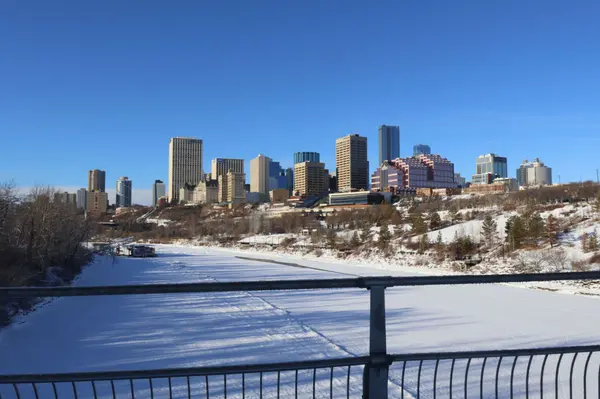
On a clear winter evening along Jasper Avenue near the Ice District, the market’s momentum feels tangible. Light from Rogers Place spills onto the snow-dusted sidewalks, while the low hum of traffic mixes with distant music from restaurants like CRAFT Beer Market. The crisp air carries a hint of wood smoke from nearby patios, and illuminated cranes over 104 Street signal ongoing residential construction that continues to reshape downtown’s skyline and long-term housing supply.
Which Edmonton neighborhoods are shaping demand in the 2026 market?
Several corridors stand out as demand leaders within the residential real estate market Edmonton professionals monitor. Mature central neighborhoods such as Glenora, Laurier Heights, and Highlands attract buyers seeking tree-lined streets, proximity to the North Saskatchewan River Valley, and relatively short commutes along Groat Road or Wayne Gretzky Drive. According to Zolo market summaries, detached homes in these areas often command premiums in the mid- to upper-price ranges compared with citywide averages.
South-central communities also hold strong appeal. Strathcona, Queen Alexandra, and Bonnie Doon offer walkable access to Whyte Avenue, the University of Alberta, and Mill Creek Ravine. Walk Score places parts of Strathcona and Garneau in the high 80s for walkability, as referenced on Walk Score. This combination of cafes, transit on 82 Avenue, and cultural venues near Old Strathcona Farmers’ Market continues to draw both end-users and investors targeting stable long-term rental demand.
Suburban growth nodes show a different pattern. Southwest communities along Terwillegar Drive and Rabbit Hill Road, including Terwillegar Towne, Leger, and MacTaggart, remain popular with households seeking newer construction and proximity to Terwillegar Community Recreation Centre. In the southeast, The Meadows area around Tamarack and Laurel benefits from access to Anthony Henday Drive and amenities at Meadows Recreation Centre, while Mill Woods continues to provide relatively accessible pricing near Grey Nuns Community Hospital and Mill Woods Town Centre.
On summer evenings in Glenora, the character of the neighborhood becomes unmistakable along 133 Street near Alexander Circle. Mature elms cast dappled shadows over stately character homes, while the soft rustle of leaves blends with distant laughter from families walking toward MacKinnon Ravine Park. The air carries the scent of freshly cut lawns and barbecues, and the low glow from porch lights along Stony Plain Road gives the area a calm, settled atmosphere that reinforces its long-standing desirability.
What price trends and affordability factors define the residential real estate market Edmonton buyers face?
Affordability remains one of the defining features distinguishing the residential real estate market Edmonton offers from other major Canadian centers. According to aggregated data from Realtor.ca in early 2026, many move-in-ready detached homes in family-oriented neighborhoods such as Klarvatten, Charlesworth, and Secord still transact in a broad range between $400,000 and $550,000. Comparable properties in Greater Vancouver or the GTA frequently start at levels near or above $900,000.
Condominium pricing shows even more attainable entry points. Based on current listings analyzed through Redfin, apartment-style condos in downtown Edmonton, Oliver, and Queen Mary Park commonly appear between roughly $170,000 and $280,000, depending on age, amenities, and proximity to LRT stations such as Corona or Bay/Enterprise Square. Townhome-style condos in communities like Rutherford, Summerside, and Castle Downs often occupy a middle band, with many listings in the vicinity of $300,000 to $380,000.
Financing dynamics further shape perceived affordability. As of 2026, insured mortgage options still allow minimum down payments near 5% on many purchases under the federal threshold, while traditional conventional financing above 20% down remains common among move-up buyers. According to rate surveys from major banks summarized by Ratehub.ca, fixed mortgage rates in Alberta through early 2026 have typically ranged between approximately 4.5% and 5.5%, influencing monthly carrying costs across all Edmonton submarkets.
How are infrastructure and development projects influencing Edmonton’s 2026 housing outlook?
Transit expansion and infill policies play central roles in shaping the residential real estate market Edmonton planners envision for the next decade. According to the City of Edmonton, the Valley Line Southeast LRT adds roughly 13 kilometers of track connecting Mill Woods to downtown, with the West phase under construction toward Lewis Farms. Properties within walking distance of new stations near Mill Woods Town Centre, Bonnie Doon, and West Edmonton Mall often experience heightened interest from both residents and investors prioritizing car-light lifestyles.
Downtown redevelopment also continues to influence demand. The Ice District surrounding Rogers Place, 104 Avenue, and 103 Street has attracted office, hotel, and residential towers, contributing thousands of new units over the past several years. Recent projects frequently feature amenity packages including fitness centers, rooftop patios, and underground parking, with some penthouse offerings surpassing $2.4M. According to Downtown Edmonton business association updates, ongoing public realm improvements aim to strengthen retail and entertainment vibrancy, further stabilizing residential interest.
Infill zoning and redevelopment initiatives extend beyond downtown. Mature neighborhoods like Westmount, Parkallen, and Bonnie Doon continue to see older bungalows replaced by duplexes, garden suites, and small-scale multifamily projects under current zoning rules. City planning documents hosted by the City of Edmonton Urban Planning department highlight a strategy focused on increasing density near transit corridors and commercial nodes, managing long-term infrastructure costs while offering a wider mix of housing forms.
What strategies can investors and homeowners use to navigate Edmonton’s 2026 residential market?
Participants in the residential real estate market Edmonton presents in 2026 increasingly focus on micro-location dynamics and building quality. Investors evaluating condominium towers near Rogers Place, MacEwan University, and the Royal Alexandra Hospital campus often differentiate between buildings with higher reserve fund contributions and those with recent capital projects, such as new building envelopes or mechanical upgrades. According to guidance from Government of Alberta condominium resources, reserve fund plans are typically reviewed every 5 years, providing important insight into long-term maintenance commitments.
For low-density neighborhoods, attention frequently centers on lot characteristics and redevelopment potential. Corner lots in Westmount, Inglewood, and Prince Charles near 124 Street can carry premiums due to options for future garden suites or small-scale multifamily assemblies under existing zoning. Proximity to amenities such as Westmount Shopping Centre, Kingsway Mall, or the revamped Blatchford district often influences both current valuations and long-term appreciation prospects, particularly as the LRT network expands through NAIT and toward northwest communities.
Risk management remains essential. Investors weighing pre-construction purchases near the Valley Line West or future transit corridors often examine builder track records, deposit structures, and projected completion timelines, which can span 3 to 6 years. According to CMHC Housing Market Outlook commentary, construction cost inflation and permitting timelines across major Canadian cities have introduced additional uncertainty, making thorough due diligence on absorption rates and surrounding land supply particularly important in Edmonton’s emerging growth nodes.
The 1.9% population growth figure cited at the start of this guide reflects durable demographic pressure underpinning Edmonton’s housing demand through 2026 and beyond. That same growth rate underscores the likelihood that both ownership and rental segments will remain competitive, particularly near transit, schools, and employment centers. The Realtors Association of Edmonton monthly statistic releases provide one of the clearest recurring snapshots of inventory, sales, and price trends across submarkets. Buyers who monitor those releases closely and register listing alerts in February ahead of the spring surge, then commit to submitting well-prepared offers within 24 to 48 hours of suitable listings, consistently gain a measurable edge over less organized participants in Edmonton’s evolving 2026 market.
FROM OUR BLOG

Buying an Acreage Near Edmonton: What to Consider Before You Make an Offer
For many buyers, acreage living represents more space, more privacy, and more freedom. It may offer room for: Workshops Gardens Recreational equipment Outdoor projects Family Pets Hobbies But buying an acreage can be different from purchasing a typical city home. The house is only part of what you a

How to Prepare Your Edmonton-Area Home for Sale
Preparing a home for sale does not mean renovating everything. The goal is to understand what buyers will compare your property against and identify which improvements are most likely to strengthen the presentation. Start with the Market Before spending money, review: Recent comparable sales Active

Moving to Edmonton: How to Choose the Right Community for Your Lifestyle
Moving to Edmonton can be exciting, but the number of communities available can make choosing where to live feel overwhelming. The right neighborhood is not simply the one with the nicest house. It is the one that fits your daily routine, budget, commute, family needs, and long-term plans. Start wit